OpenAI opens its agent harness, Anthropic details eight months of misuse
OpenAI put its Codex agent harness behind a public API, Anthropic published eight months of disrupted Claude misuse, Washington cut a new federal AI pricing deal, and the DOJ opened an antitrust probe into Nvidia's Groq deal.
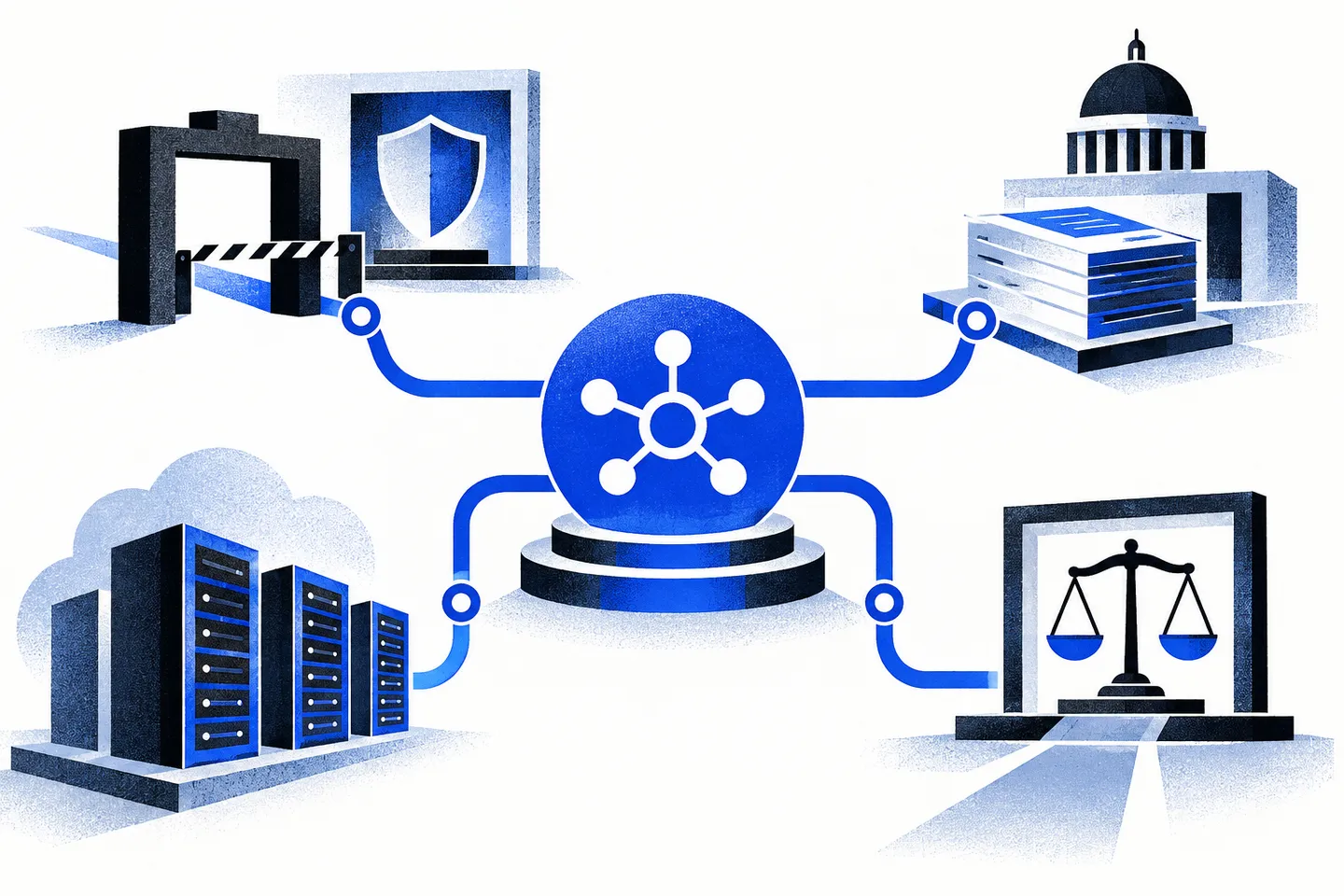
OpenAI puts its Codex harness behind a public API
OpenAI opened a public beta of its Agents API, exposing the session-and-orchestration harness that already powers Codex so developers can build agents without assembling that infrastructure themselves. The design centers on four pieces: an Agent (model, instructions, tools, MCP servers), an optional sandboxed Environment, a durable Session, and the stream of events a session emits. Inside a session, an agent can run code, edit files, search the web, apply skills, and split work across subagents under a set concurrency limit. Developers can run agents in OpenAI’s managed sandboxes or their own infrastructure, with launch integrations from Cloudflare, DigitalOcean, and Oracle. OpenAI says it will iterate on the beta based on developer feedback rather than treating it as a finished product.
Anthropic publishes eight months of disrupted Claude misuse
Anthropic released its latest threat intelligence report, documenting misuse of Claude that its Threat Intelligence team disrupted between December 2025 and August 2026 across seven harm areas: cyber operations, influence operations, surveillance, scams and fraud, biological misuse, conventional weapons development, and illicit model distillation. The report says state-sponsored groups, financially motivated criminal operations, and other actors increasingly used Claude as one execution node inside larger multi-agent attack chains, rather than as a standalone tool. It also details a specific distillation case, tracked as GTG-16001, in which a party relayed millions of user requests to Claude Opus without those users’ knowledge over a two-week span, exposing sensitive material in the process. Anthropic frames the disclosures as evidence that its detection systems catch this activity, though the report necessarily covers only the misuse the company found and stopped, not what may have gone undetected.
Washington swaps OpenAI’s $1 pilot for a 50% federal discount
The General Services Administration and OpenAI announced a new 27-month OneGov agreement replacing the nominal $1-per-agency pricing that has run since 2025. Starting October 1, federal, state, local, and tribal agencies get token-based ChatGPT pricing at a 50% discount off standard rates, with the standard $15-per-user monthly license fee dropped to zero and no minimum spend commitment, according to Nextgov/FCW and Bloomberg. GSA credits the outgoing pilot with $1.4 billion in reported savings across roughly 3.5 million federal users. The shift signals that OpenAI expects sustained government usage to justify usage-based billing rather than another flat-fee promotional period.
Oracle’s cloud infrastructure revenue more than doubles
Oracle reported fiscal Q1 2027 results with cloud infrastructure revenue up 121% year-over-year to $7.4 billion, part of $19.3 billion in total revenue, up 30%. The company said GPU utilization across its AI cloud ran at 97.9% and it added 850 megawatts of data center capacity in the quarter. Remaining performance obligations reached $664 billion, including more than $30 billion in new AI cloud contracts signed during the period. Oracle raised its full-year guidance to at least $90 billion in revenue, betting that demand for AI training and inference capacity keeps outpacing what it can build.
DOJ opens an antitrust inquiry into Nvidia’s Groq licensing deal
The Justice Department is investigating whether Nvidia structured its licensing arrangement with AI-chip startup Groq, reportedly worth $17–20 billion, to avoid antitrust review, according to Axios and Bloomberg, both citing people familiar with the matter. Nvidia paid for a non-exclusive license to Groq’s chip technology and hired several of its executives, including founder Jonathan Ross, rather than acquiring the company outright — a structure that can fall outside standard merger-notification thresholds. The DOJ has sent Nvidia a formal request for information; officials could seek a fine if they conclude the deal was shaped to sidestep scrutiny, though unwinding it is considered unlikely. Nvidia said the arrangement is “the American system working as designed to promote innovation, reward entrepreneurs, and benefit consumers.” It is not yet clear whether the inquiry will extend to similar licensing-and-hiring deals elsewhere in the industry.